A plastic pipe has a problem in a fire. It melts.
The pipe goes soft, shrinks and burns away. What was a pipe a minute ago is now an open hole through a fire wall.
A collar or a wrap is there to deal with that.
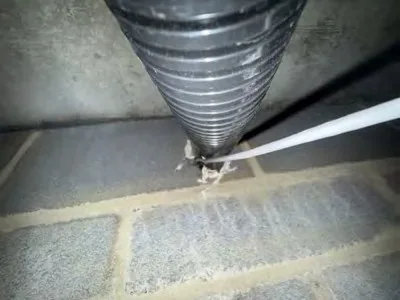
How they work
Both contain an intumescent material. It sits quiet until it gets hot, then swells.
As the pipe softens, the material expands inwards and squeezes it shut. By the time the pipe has burned away, the hole is already closed.
That is why the product has to match the pipe. Material, diameter, wall thickness and the wall it passes through all affect how much the product has to do.
Collars
A collar is a metal ring with the intumescent material inside. It is fixed round the pipe where it leaves the wall or ceiling.
Collars are what you find where a soil pipe or waste pipe comes through a floor. They sit under the slab, one at each floor the pipe passes through.
Some are cast in when the floor is poured. Others are fitted afterwards, which is the case for most repair work.
Wraps
A wrap is a strip of intumescent material that goes round the pipe like a bandage. It is cut to length and wound on, then held with a tie or wire.
Wraps suit pipes in tight spaces where a rigid collar will not fit, or where a pipe has been added to an existing hole.
The number of layers depends on the pipe size and the product's test. It is not a guess. We follow the manufacturer's table for each one.
Where things go wrong
A collar sized for a 50mm pipe clamped round a 110mm one. Each product is tested on stated pipe sizes and materials, and outside them the test says nothing.
A collar fixed with the wrong screws, so it hangs off the ceiling after a few years of vibration.
A wrap with two turns where the table asks for three.
A pipe boxed in with plasterboard and no seal where it enters the box.
A pipe swapped for a different one by a plumber, with the old collar left round a pipe it was never tested on.
What we need to know
Pipe material and diameter. Not sure? Lay a tape measure along it and take one photo. Wall or floor? And how many? Forty collars in a day work out cheaper each than two on a visit.
What you get
Each collar and wrap labelled, photographed and entered in a schedule. Our BM TRADA / FIRAS-certificated contractors do the fitting.
Questions we get asked
Can you fit a collar to a pipe that is already in?
Yes, and it is routine. Hinged and split collars close round a pipe without cutting it. Behind a basin or in a boxed corner a wrap goes on instead.
Do I need one on every floor?
Often, but the design of the building decides. The original drawings or your assessor's report should say which floors.
Does a metal pipe need one?
A cast iron stack stays put in a fire, so it needs no collar. The gap round it still needs a seal, which is covered under penetration sealing.
Tell us what is going through it and what the wall is made of. We will come back with a price.
Get a price