A tube of mastic costs a few pounds. That is the problem. It looks like the simplest job in the building, so it gets done by whoever is nearest with a gun.
Fire-rated mastic has been through a furnace test for a set time. The intumescent kind also swells when it gets hot and pushes into the gap. Ordinary decorator's caulk does neither, and it is the same grey as the good stuff.
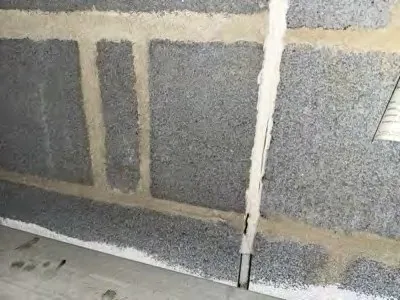
Where mastic is the right choice
Narrow and long. You could trace the gap with a pencil. The vertical joint between two blocks in the photo. The line along the top of a wall under the slab. A window frame against its reveal. One cable through a snug hole, a few millimetres of play round it.
Where it is the wrong choice
Big holes. Past a certain width and depth nobody has tested mastic, so it is batts or coated board, as on the penetration sealing page.
Plastic pipes too. The pipe melts away and the mastic is left holding a gap with nothing in it. Those need a collar or wrap.
Movement joints that open and close all day are out as well, unless the product says it takes the movement.
What we check first
Width and depth. Every product has a tested range and we stay in it.
What is behind. A strip of mineral wool goes in first for the bead to press on. Bead over air sags.
Dust and damp. Both stop it sticking. Old sealant comes out too.
Bead depth. Too thin does nothing, and too thick cracks as it dries.
What you can check yourself
Fire-rated mastic usually comes in a different colour from builder's sealant. Red, grey and white are all common. You cannot tell by colour alone.
The surest way is a label. We mark each seal with the product, the date and who fitted it, and photograph it before and after.
If you find a seal in your building with no label, and nobody can say what is in it, treat it as unproven.
What you get
A photographed schedule, with a seal against each gap. The mastic work is done by our BM TRADA / FIRAS-certificated contractors, alongside any batts, collars or barriers that the same job needs.
Questions we get asked
Can I use ordinary silicone?
No. Ordinary silicone is not tested as a fire seal. See our short answer on expanding foam and sealant.
Does mastic last?
Fire-rated products are made to last, but not forever. They can dry out, crack or be damaged by later work. They need to be looked at now and then.
Can I fix a gap myself?
You can, if you use the right product the right way. Most people choose the wrong one, so we would rather you asked.
Tell us what is going through it and what the wall is made of. We will come back with a price.
Get a price